

Workshops & Courses
研讨会与课程
Enhance Your Skills and Network through
ATBC2026 Workshops and Courses!
Registration is now closed
Below you will find a list of pre-conference and in-conference workshops and training courses offered as part of ATBC2026.
Workshops and Courses are open to all registered conference participants at no additional cost.
Please note that enrollment in any workshop or course is only valid if you have completed your main conference registration. If you have not yet registered for the main event, your selections will not be considered confirmed.
Important:
Do not select workshops/courses scheduled on the same day, as they will take place in overlapping time slots.
Spots are limited and assigned on a first-come, first-served basis. Please enroll only if you are certain you will attend, to ensure fair access for all participants.

Pre-conference Workshops and Courses
If you are interested in these sessions, we recommend registering for only one pre-conference session to ensure a focused experience.
However, if you choose to attend more than one, please make sure there are no scheduling conflicts between the sessions you select.
The pre-conference activities will take place at XTBG
C-FB

Field Course
Deadline for registration - MAY 13th!
Field Botany Course, or How to Become a Good Botanist
June 23th-26th, 2026
Organizer(s):
Prof. Ferry Slik (Curator of the Universiti Brunei Darussalam Herbarium (UBDH)) & Prof. Tan Yunhong (Xishuangbanna Tropical Botanical Garden, Chinese Academy of Science)
This course will teach you the basic skills of botany. It consists of a mix of lectures and hands-on activities. We will start with an historical overview of modern taxonomy that includes information on plant classification, how to collect plants and how to describe new species. The course will have practical modules on 1) plant collecting, pressing, drying and voucher preparation, 2) making identification keys, 3) botanical drawing, 4) macro-photography, and 5) identification of collected plant material. Outdoor teaching and plant collecting will use the gardens and protected forests of the Xishuangbanna Tropical Botanical Garden (XTBG).
Independent registration is needed (Click on learn more)
C-AS

Course
Advanced Statistics Course
June 22th-26th, 2026
Organizer(s):
Kyle Tomlinson, Xishuangbanna Tropical Botanical Garden, Chinese Academy of Science
This course builds on foundational statistics and covers a range of methods widely used in modern-day ecology and conservation research, starting from simple linear models and generalised linear models, to mixed effects models with grouped random effects, and linear models with covariance structures for random effects that cannot be grouped. Each topic of the curriculum builds upon the previous one, guiding participants from basic to advanced concepts. By the end of the course, participants will gain practical skills to confidently apply these methods to your own research.
W-PC

Workshop
Tropical plant cryo-conservation – challenges and options
Saturday, June 27th, 2026
Organizer(s):
Prof Hugh W. Pritchard, Dr CHEN Hongying, Dr LIN Liang, Dr HU Xiaojian (CAS-KIB), Dr WEN Bin (CAS-XTBG)
This workshop will introduce and debate the background to and progress in cryo-conservation for a range of plant materials, from pollen to seeds. Participants are encouraged to bring their research challenges to discuss.
W-4

Workshop
Emerging Applications of Large Language Models in Ecology and Conservation Science
Saturday, June 27th, 2026
Organizer(s):
Christos Mammides, Xishuangbanna Tropical Botanical Garden
This workshop introduces participants to the emerging capabilities of LLMs, their relevance to ecological research, and best practices for incorporating them into analytical workflows.
Max. 40 participants
C-16
Course
Flexible species distribution models based on presences or abundances with flexsdm and adm R packages.
Saturday, June 27th, 2026
Organizer(s):
Santiago Velazco, San Diego State University; Miranda Rose, San Diego State University; Admir de Oliveira Junior, Universidade Federal de Integração Latinoamericana
A hands-on training in reproducible Species Distribution and Abundance Modeling using the flexsdm and adm R packages, guiding participants through data preparation, different algorithm fitting, hyperparameter tuning, and output exploration.
Max. 40 participants
W-23

Workshop
Create an open-access online learning module to share your own tropical biology research
Saturday, June 27th, 2026
Organizer(s):
Ann Russell, Iowa State University
Learn about creating online learning modules based on your own research through the OCELOTS network (Online Content for Experiential Learning of Tropical Systems). Working with specialists in pedagogy, interactive data tools, and media, tropical biologists create modules on a user-friendly, open-access platform with multi-lingual capacity.
Max. 40 participants
W-33

Workshop
Meta-analysis and reproducibility: publishing fast and following scientific research ethics
Saturday, June 27th, 2026
Organizer(s):
Zakari Sissou, University of Parakou; Gbadamassi Dossa, Xishuangbanna Tropical Botanical Garden; Denis Njoroge, Technical University of Dresden
This session is a training on meta-analysis which usually overcomes the limitations of individual studies by quantitatively synthesizing existing evidence to provide a precise, robust, and reproducible estimate of the true effect, thereby informing reliable conclusions and guiding future research and policy.
Max. 40 participants
In-conference Workshops and Courses
If you are interested in participating in in-conference workshops, please select a maximum of one workshop per day, as these activities are scheduled in the same time slot. Please note that parallel oral sessions will also be taking place during these times.
These workshops will be held at the main conference venue
Be sure to review the schedule carefully to avoid any conflicts and to make the most of your participation.
W-30

Workshop
Towards a decolonized and impactful tropical biology research: initiating a methodological debate and discussion
Wednesday, July 1st, 2026
Organizer(s):
Sumita Chatterjee, Independent; Vinita Gowda, IISER Bhopal; Bea Maas, University Of Vienna
This panel will create an open dialogue between researchers who have intentionally integrated inclusive, decolonial practices into their work and those who recognize their positional power and seek guidance on developing more equitable approaches in their own research and labs.
Max. 50 participants
W-11

Workshop
Scaling conservation data with EarthRanger + Ecoscope; from field data to dashboards
Tuesday, June 30th, 2026
Organizer(s):
Yun Wu, Wildlife Dynamics INC; Antony Lynam, Allen Institute for AI
EarthRanger and Ecoscope help turn fragmented conservation data into actionable insights, revealing the need for stronger local capacity, outcome-focused monitoring, and standardized workflows to improve efficiency and ecological impact across protected areas.
W-13

Workshop
Fostering Cross-border Collaborations: Lessons from ASEAN for Strengthening Regional Partnerships
Tuesday, June 30th, 2026
Organizer(s):
Xin Yi Chong, National University of Singapore
An interactive workshop where participants and facilitators collaboratively explore lessons from ASEAN and beyond to co-create a toolkit for effective, equitable regional partnerships in tropical conservation.
Max. 30 participants
W-7

Workshop
Turning Sound into Discovery: Using Wildlife Audio Recorders as a Valuable Research Tool
Wednesday, July 1st, 2026
Organizer(s):
Nicole Wright, Wildlife Acoustics
Join us for a hands-on workshop that teaches the fundamentals of bioacoustics and how to successfully set up, configure, and deploy the Song Meter Micro 2 for wildlife monitoring.
Max. 30 participants
C-43
Course
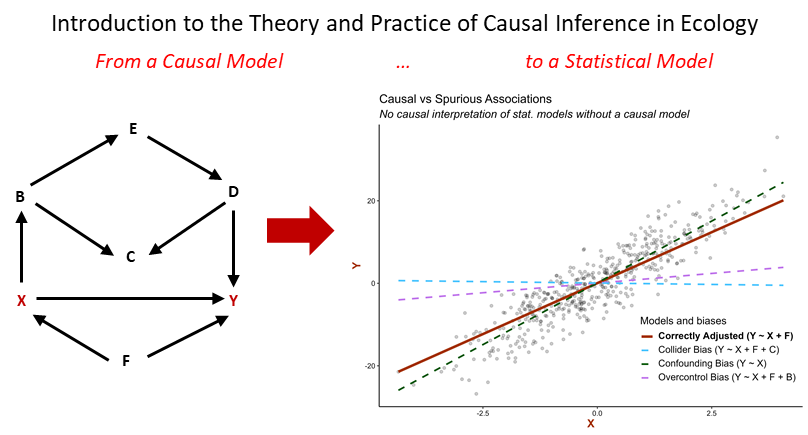
Introduction to the Theory and Practice of Causal Inference in Ecology
Monday, June 29th, 2026
Organizer(s):
David Bauman, French National Research Institute for Sustainable Development (IRD)
This course introduces Structural Causal Modeling (SCM) in Ecology, teaching participants to use causal diagrams and statistical tools (dagitty, R) to distinguish causal from spurious associations, identify control variables, and justify causal inference, bridging the gap between experimental and observational studies while addressing common pitfalls in ecological research.
Max. 30 participants
W-65

Workshop
ATBC Chapters - Building ecology and evolution networks within the tropics
Thursday, July 2nd, 2026
Organizer(s):
Vinita Gowda, IISER Bhopal; Randriamalala Onja, University of Antananarivo; Vania Tejeda-Gómez, NODO Conservation
ATBC Chapters: connecting people and building research networks across Asia-Pacific, Africa, and the Neotropics
W-68

Workshop
Prioritizing Social-Ecological System Variables of Human-Elephant Conflict in China-Laos Transboundary Region
Thursday, July 2nd, 2026
Organizer(s):
Yang Zhang, University of Reading; Li Li, China Agricultural University
This workshop identifies and prioritizes key social-ecological variables driving transboundary human-elephant conflict in the China-Laos transboundary region, aime to support evidence-based research, policy and on-the-ground conservation.
Max. 30 participants

Field Botany Course, or How to Become a Good Botanist
June 23-26, 2026
Deadline for applications: May 13th, 2026
Instructors: Prof. Ferry Slik, Curator of the Universiti Brunei Darussalam Herbarium (UBDH); Prof. Tan Yunhong, Xishuangbanna Tropical Botanical Garden, Chinese Academy of Science.
This course will teach you the basic skills of botany. It consists of a mix of lectures and hands-on activities. We will start with an historical overview of modern taxonomy that includes information on plant classification, how to collect plants and how to describe new species. The course will have practical modules on 1) plant collecting, pressing, drying and voucher preparation, 2) making identification keys, 3) botanical drawing, 4) macro-photography, and 5) identification of collected plant material. Outdoor teaching and plant collecting will use the gardens and protected forests of the Xishuangbanna Tropical Botanical Garden (XTBG).